 English
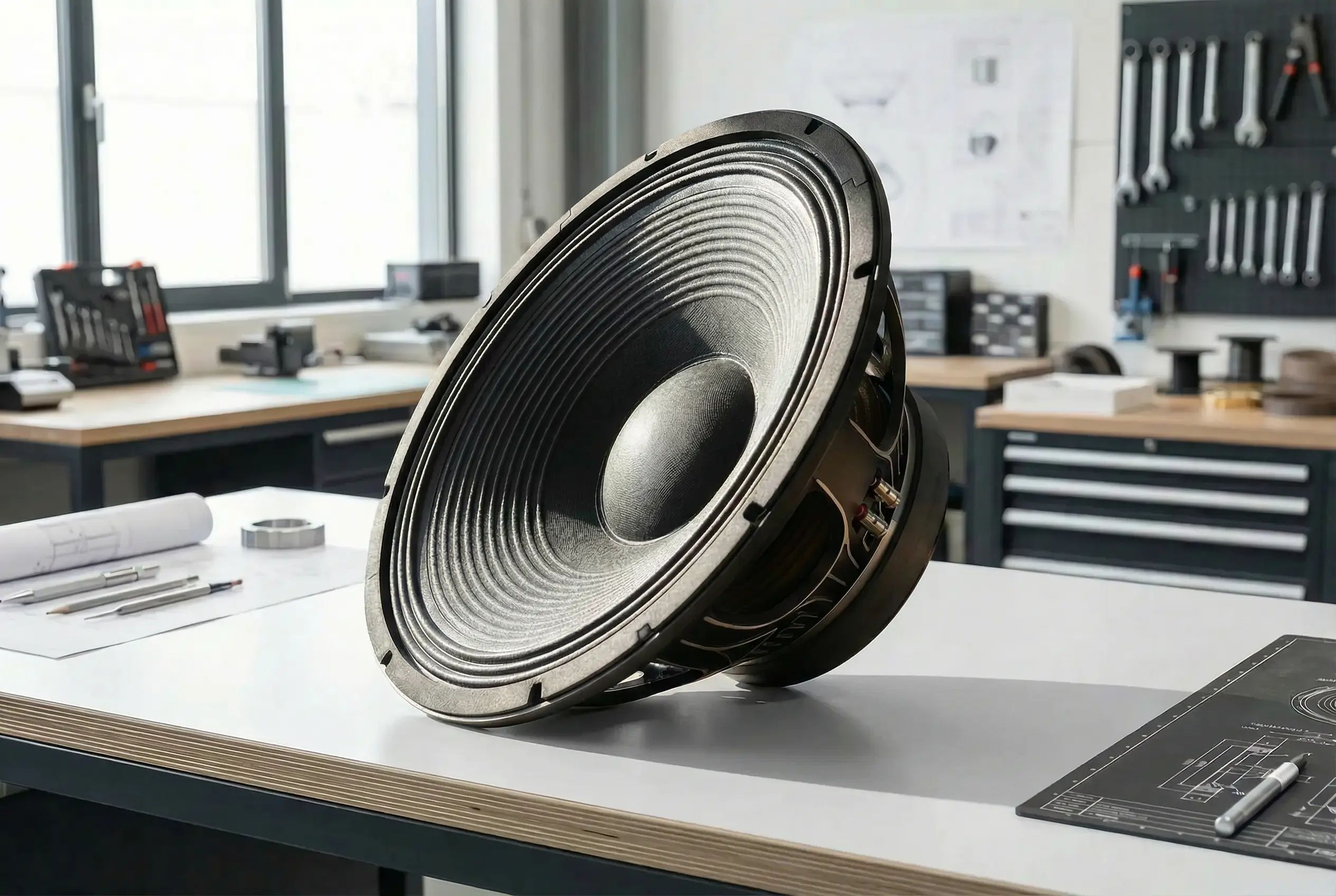
In professional PA loudspeaker design, discussions often focus on power handling, voice coil diameter, or magnet strength. However, one critical component is frequently underestimated: the surround.
For high-power, high-SPL PA drivers, the surround is not a cosmetic or secondary part—it plays a fundamental role in controlling cone motion, maintaining linearity, and ensuring long-term reliability under demanding conditions.
This article explains how different surround shapes influence sound quality and performance in professional loudspeaker systems, from an engineering perspective.
1. The Role of the Surround in High-Power PA Drivers
The surround connects the cone to the basket and serves several essential functions:
• Provides mechanical support for cone excursion
• Controls linear displacement (Xmax)
• Contributes to compliance and damping
• Stabilises the cone during high-power operation
In large-format PA drivers, where cones operate under high excursion, high thermal stress, and high acoustic load, the surround must be designed as part of the entire electro-mechanical system—not as an afterthought.
2. Common Surround Shapes and Their Acoustic Characteristics
Flat Surround
Structural characteristics
• Minimal curvature
• Low mechanical compliance
• Simple construction
Acoustic behaviour
• Fast transient response
• Clean midrange reproduction
• Limited low-frequency extension
• Reduced stability at high excursion
Typical applications
• Lower power drivers
• Midrange or mid-bass applications
• Systems where extreme low-frequency output is not required
In high-power PA woofers, flat surrounds are rarely used due to limited excursion control.
Single-Roll Surround
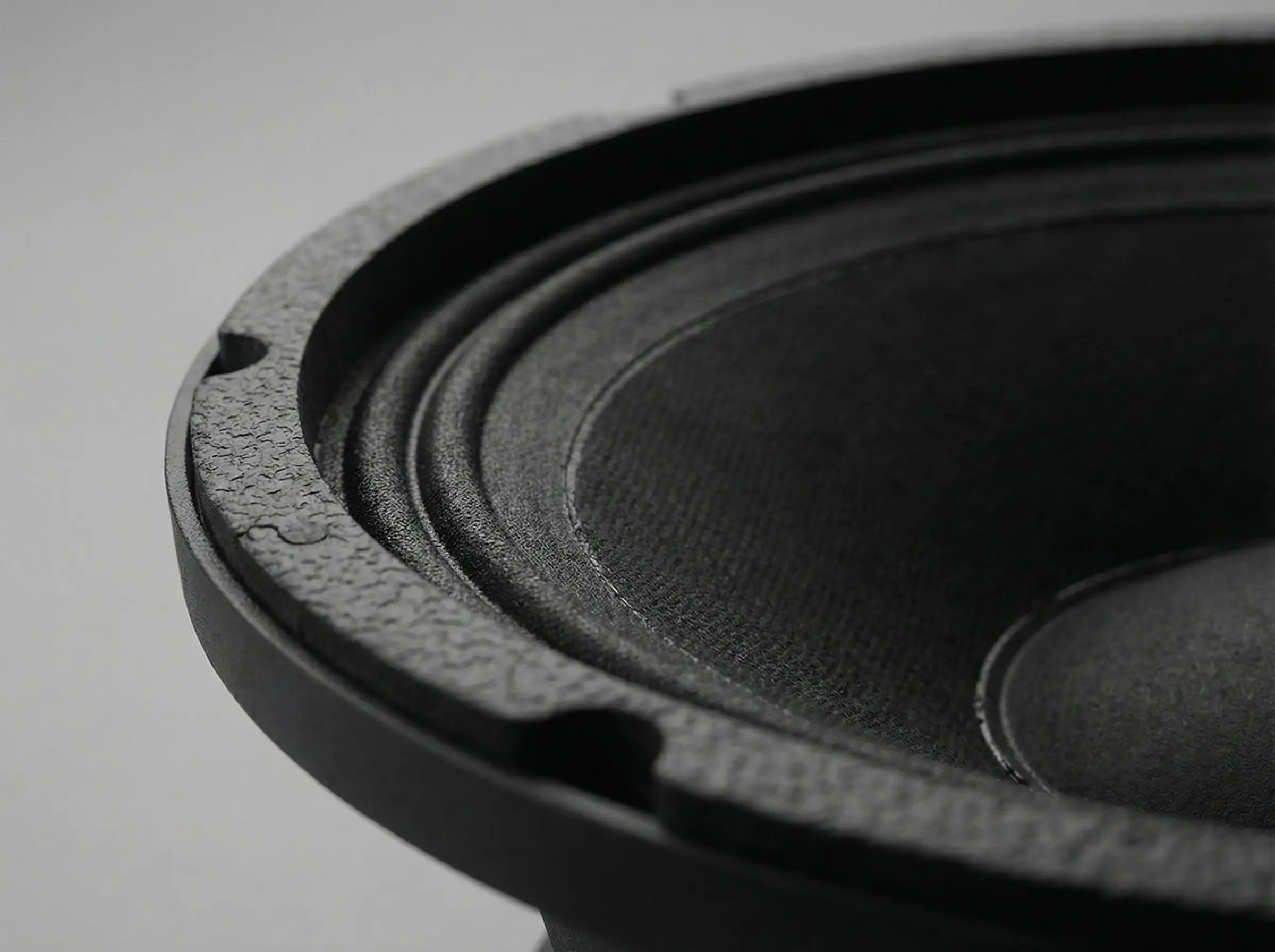
Structural characteristics
• One curved roll
• Balanced compliance and control
Acoustic behaviour
• Solid low-frequency punch
• Stable dynamic behaviour
• Good balance between control and flexibility
Typical applications
• Mid to high-power PA woofers
• Systems requiring controlled bass with clarity
This is one of the most widely used surround types in professional PA drivers.
Double-Roll Surround
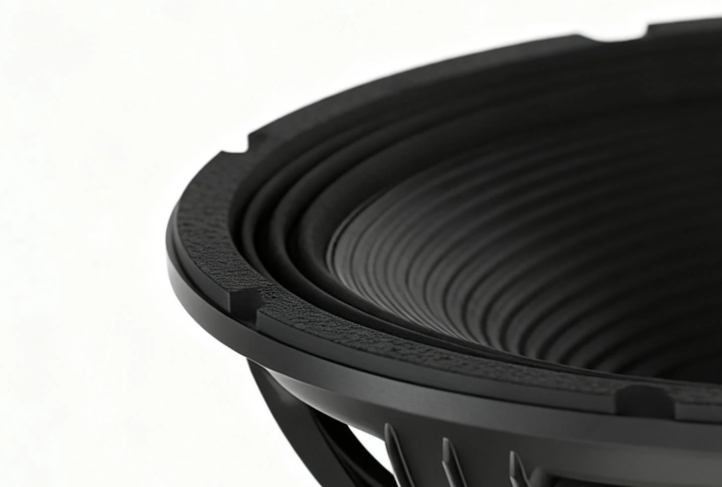
Structural characteristics
• Two curved rolls
• Increased excursion capability
• Strong restoring force
Acoustic behaviour
• Deeper low-frequency extension
• Lower distortion at high SPL
• Improved stability during large excursions
Typical applications
• High-power low-frequency drivers
• Touring-grade and outdoor PA systems
• Large-format enclosures
For demanding PA environments, the double-roll surround is often the preferred solution.
Damped or Treated Surround
Structural characteristics
• Fabric treated with damping compounds
• Higher internal energy loss
Acoustic behaviour
• Reduced resonances
• Cleaner mid-bass response
• Slight reduction in sensitivity
Typical applications
• Precision-controlled PA systems
• Fixed installations
• Applications prioritising tonal accuracy over maximum efficiency
3. How Surround Shape Affects Perceived Sound
From a system-level perspective, surround design influences:
• Low-frequency extension and control
• Dynamic stability at high SPL
• Mid-bass clarity and definition
• Distortion behaviour under load
• Long-term mechanical reliability
In professional systems, surround geometry directly affects how “tight,” “controlled,” or “muddy” the bass is perceived—especially under real-world operating conditions.
4. ZTZ Speaker’s Approach to Surround Design
At ZTZ Speaker, surround design is treated as a core engineering decision rather than a visual or marketing choice.
Our design principles include:
• Application-driven geometry: surround profiles matched to specific power classes and frequency ranges
• High-SPL optimisation: stability under large excursion and sustained power
• System-level integration: surround, cone, voice coil, and motor designed as a unified structure
• Balanced performance: linearity, control, and durability without sacrificing musicality
This approach ensures that our professional drivers perform consistently in real PA environments—on stage, in fixed installations, and in demanding sound reinforcement systems.
5. Conclusion
In professional audio, sound quality is never determined by a single parameter.
Surround shape plays a critical role in defining control, stability, and tonal balance—especially in high-power PA loudspeakers.
A well-engineered surround allows the driver to deliver deep, controlled bass, clean mid-bass response, and reliable performance over time.
At ZTZ Speaker, we design surrounds to serve the system—not the spec sheet.