 English
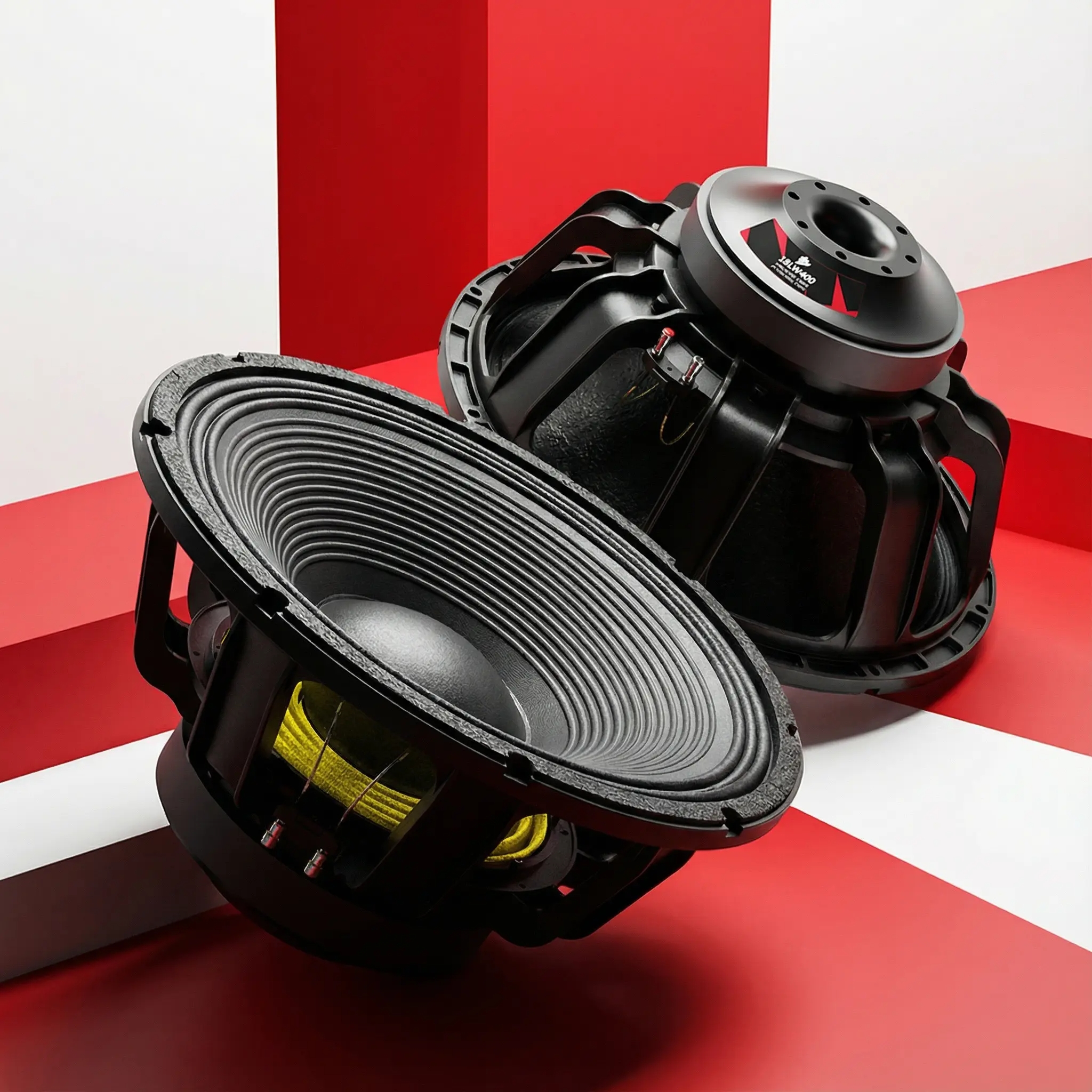
In professional loudspeaker design, the cone is not a cosmetic component.
Its geometry, stiffness distribution, damping behavior, and interaction with adhesives all directly determine how the driver behaves under real operating conditions.
For large-diameter(18’’ and some 15’’), high-power drivers, ZTZ Speaker consistently adopts corrugated cone structures. This is not a stylistic choice, but the result of long-term engineering decisions focused on control, predictability, and sound quality.
1. Full-Surface Corrugation: Structural Control from the Start
Unlike designs where corrugation is limited to the edge or specific zones, ZTZ Speaker employs corrugation across the entire cone surface.
This approach allows mechanical stress to be distributed more evenly when the cone operates at large excursions. In high-power applications, smooth cones tend to develop localized flexing, modal breakup, or asymmetric deformation. Fully corrugated cones significantly reduce these risks by maintaining structural integrity throughout the effective radiating area.
Key benefits include:
- Improved stiffness-to-weight ratio across the cone
- More uniform piston-like motion at high excursion
- Reduced nonlinear distortion under high sound pressure levels
2. Controlled Compliance: Firm, Not Rigid
Fully corrugated cones used by ZTZ Speaker are typically designed with relatively firm compliance. This should not be interpreted as excessive stiffness, but as a controlled mechanical boundary.
In high-power drivers, uncontrolled compliance often leads to delayed response, energy storage, and loss of definition. A firmer cone structure helps maintain control when excursion and thermal load increase, ensuring that energy is converted into sound rather than unwanted mechanical movement.
The result is tighter low-frequency reproduction and more predictable behavior under dynamic load.
3. Unified Adhesive System: A System-Level Design Choice
Cone geometry alone does not define the behavior of a driver.
ZTZ Speaker applies a unified adhesive system within each driver series, using the same adhesive formulation for the cone, dust cap, and suspension interfaces.
This approach ensures:
- Consistent mechanical damping across all vibrating components
- Stable energy transfer between parts
- Greater freedom during final acoustic tuning
In this context, adhesive selection is not merely about bonding strength—it is an integral part of the mechanical and acoustic system.
4. Corrugation as a Mechanical Low-Pass Filter
An often overlooked advantage of fully corrugated cones is their natural low-pass filtering behavior.
The concentric “ribs” that reinforce the cone also help attenuate high-frequency parasitic vibrations that do not belong to a low-frequency driver’s operating range. This results in cleaner output, reduced high-frequency artifacts, and a more controlled tonal balance.
In engineering terms:
Form serves function, and function ultimately serves sound quality.
5. From “Clean” Bass to Modern High-Power Performance
Corrugated cone designs are not new. Decades ago, certain classic manufacturers used similar structures to achieve smooth, controlled bass with minimal coloration.
What has changed is the evolution of materials, fiber treatments, and manufacturing precision. Modern corrugated cones can now support higher power levels, larger excursions, and more defined sonic character without sacrificing control.
In today’s professional audio environment, especially for large-diameter subwoofer drivers exceeding 600W AES, smooth cones have become increasingly rare. Fully corrugated designs are now the standard for high-output, low-distortion performance.
6. Engineering Decisions Reflected in Sound
By combining fully corrugated cone geometry, controlled compliance, and a unified adhesive system, ZTZ Speaker’s large-diameter drivers deliver:
- Deep, controlled low-frequency extension
- Fast transient response without overhang
- Reduced high-frequency artifacts
- Stable performance under sustained high power
These characteristics are not the result of trend-driven design, but of deliberate engineering choices.
Conclusion
Cone design is not about how it looks, but about how it moves under load.
ZTZ Speaker’s commitment to fully corrugated cones reflects a clear understanding of the relationship between structure, control, and sound quality. When form is genuinely designed to serve function, the result is not just higher output—but cleaner, more reliable, and more predictable sound.